Chosen family
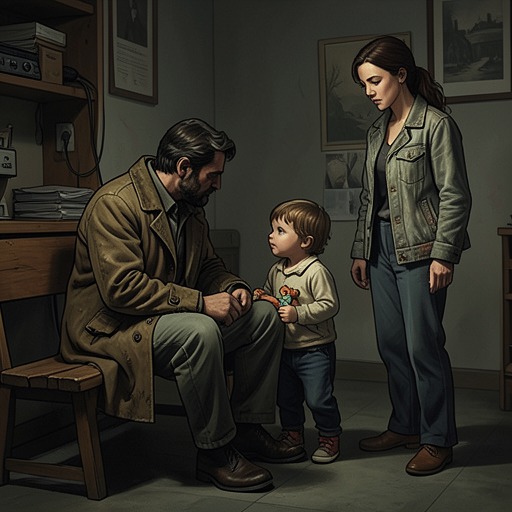
The Dog StarsChosen family is the kinship Hig finds among people with whom he survives after the old social order has failed. Its decisive expression comes when he flies back to the airfield and realizes that Bangley—not the family he has lost—is the person to whom he is returning home. The novel makes that recognition concrete through their shared defenses, the care Cima gives Bangley, Pops’s arrival as a neighbor, and the domestic rituals that gradually take shape around them.
Survival Before Kinship
Hig and Bangley’s partnership begins as a bargain struck without negotiation. Its terms are practical: the airfield offers a perimeter, water, power, food, firepower, and access to nearby mountains if game becomes scarce. Bangley sees simplicity as protection. With only the two of them, he reasons, there are no internal factions or politics to tear the arrangement apart. In a world where other groups have not survived, the partnership’s small size appears to be a strategic advantage.
But survival requires more than a defensible perimeter, and the two men do not share a single moral code. Bangley’s principle is to treat visitors as guilty and act before they can threaten the pair; Hig resists that presumption, believing that a visitor should be allowed time to show whether they are human. The disagreement exposes a fault line within the alliance: Bangley sees hesitation as a danger to both men, while Hig sees the refusal to offer anyone a chance as a danger of another kind. Their connection is therefore neither effortless nor based on sameness. It persists across a real conflict about how much trust a survivor can afford.
A Home Under Ecological Pressure
The airfield’s security is never complete. Hig is alarmed by the changing seasons: old benchmarks have become unreliable, and mountain snow has been scarce in successive winters. The loss of trout is already serious; the prospect of losing the creek itself is worse. Later, as summer advances, the water drops visibly, exposing more of the creek bed and raising the prospect that fish and other life dependent on the stream will die. Drought is not an abstract threat to this household. It bears directly on the water and food that make survival possible.
The landscape offers signs of both loss and persistence. Trout and elk are gone, while Bison, Wolves, and Bighorn sheep move back toward their former range. Osprey and Bald eagles appear around Jasper’s creek; spruce, fir, and aspen begin returning among miles of dead forest. This uneven recovery gives the idea of home a fragile setting: the people around the airfield can make a community, but their loyalty does not restore the vanished species or cancel the environmental pressures on their lives. Their bond is built within a place that remains unsettled.
Care Becomes a Shared Practice
The group’s ties deepen through practical attention to one another. When Bangley needs someone to monitor him continuously, Cima and Hig take turns. Her care is not presented only as a clinical task. Hig watches her speak to Bangley with respect and humor, as one friend to another, while she checks his splint and rewraps his bandages. The detail matters because it shows Bangley being treated as a person within a relationship, not merely as the tough partner whose usefulness once helped secure the airfield.
Hig’s response to Cima also marks an emotional change. Over the week, something that had been dormant in the canyon comes into the open, and he recognizes its growth without being able to explain it fully. He is drawn to the confidence and skill she brings to her care, as well as to the ordinary movements that place her within the household’s life: tending the lambs in the shade and joining him at the pond. These details extend kinship beyond crisis management. Care, shared work, and affection begin to belong to the same life.
Pops’s move into a house beside Bangley’s further enlarges the household. Even in recovery, he acts with tactical caution: he takes an upstairs room overlooking the airfield and sandbags its window. He then approaches Bangley to ask for a Sig Sauer rifle. Bangley is well enough by the tenth or eleventh day to sit up and consider the request. Their meeting is restrained but revealing. Pops’s half-grin recalls Bangley’s, and he touches Bangley’s bandaged forearm in a gesture Hig recognizes as respectful. The two men’s resemblance and ease suggest a new affinity within the group, formed not by a declaration but by shared habits of vigilance and regard.
Returning Home
When Hig flies back over the airfield, he sees the prairie, the last pines at the perimeter, and the tower he and Bangley built together. From above, he avoids looking closely at the remains of the dead left around the place. What comes into focus instead is his feeling for Bangley. Hig recognizes that the stubborn man with the gravelly voice has become his family, and that returning to the airfield means returning to him. The recognition is sharpened by contrast: Hig names the wife, child, and mother who are not the object of this particular homecoming, then locates home in the living bond that remains.
The family’s domestic life is not a return to the world that existed before. They sleep outside into October, piling quilts together and wearing wool hats through frosty nights. Hig and Cima name familiar winter constellations, then invent others when their store of known names runs out: his tend toward animals, hers toward food. He names one for a scrappy dog who loved fish. Such rituals do not erase grief or make the airfield safe from drought and violence. They show how a place maintained as a defensive perimeter can also become a home, and how chosen kinship takes shape through the repeated acts of staying, caring, remembering, and imagining together.